
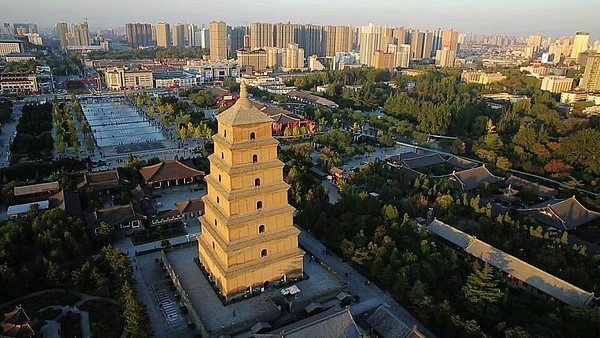
Xi'an, which was called Chang'an in ancient times, is the capital city of China's Shaanxi province and the largest designated central city in Northwest China. The total area of Xi'an is 10,752 square kilometers, and its population is 12 million. Located in the middle of the Guanzhong Plain, Xi'an is one of the three international metropolises.
Xi'an was the ancient capital of China and a cradle of civilization together with Athens, Cairo and Rome. It was the starting point of the ancient Silk Road. As a famous historical cultural city, Xi'an boasts the world’s richest cultural heritage and the most complete preservation of the ancient city and moat system. With more than 7,000 years of civilization, more than 3,100 years of city building and over 1,100 years of capital establishment, Xi'an can justly be called an "Open Air Historical Museum"; and indeed it has a total of 126 museums. The Qin Shihuang Mausoleum Terracotta Warriors and Horses, Big Wild Goose Pagoda, Little Wild Goose Pagoda, Tang Chang'an City Daming Palace Site, Han Chang'an City Weiyang Palace Site, and Xingjiao Temple Pagoda have all been inscribed in the World Heritage List.
Xi'an is a highland of science and education, as well as a key post of military industry. The comprehensive strength of science and education ranks third in Cities of China, with 63 universities and colleges, seven military academies, 43 graduate training institutes and 95 scientific research institutes. It has been rated as “China's leading smart city” and one of “the country's top ten innovative cities". Xi'an is second only to Beijing in basic strength of defense science and technology, with 44 military units and 207 investment and management units. The industry base is complete and strong. It boasts electronics, machinery, chemicals, materials, surveying, automatic controls, aerospace, aviation and other fields at a first-class and world-leading level. Xi'an is building a "3+1" trillion-level industrial cluster around advanced manufacturing, high-tech industry, modern service industry and cultural tourism industry, and a “global metropolis of hard science and technology” around "eight pillar forces" of hard science and technology such as aerospace, optoelectronic chips, new energy, new materials, intelligent manufacturing, information technology, life science and artificial intelligence.
Welcome to Xi’an!
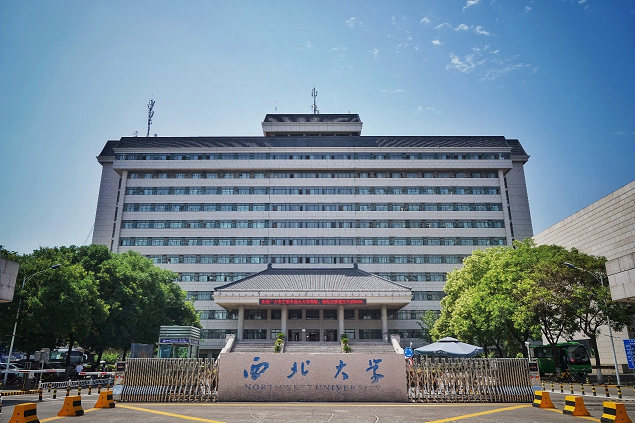
Northwest University (NWU) is a comprehensive and key national University,which is located in Xi’an, the capital city of China's Shaanxi province.It is also one of the first universities with “First-Class Discipline”and “211 Project”.
Northwest University (NWU) can trace its origins back to Shaanxi Imperial College and Peking Imperial College in 1902. The University received its current name in 1912, and was renamed Northwest National University in 1923. With institutions such as Peking National University, Peking National Normal University and Beiyang National Engineering College, which moved inland to Shaanxi province when the War of Resistance against Japan broke out in 1937, the University merged to form Xi’an National Provisional University. It was then renamed Northwest Associated University in 1938 and regained the name Northwest National University in 1939. In the early years after the founding of the People’s Republic of China, Northwest University was a comprehensive university under the direct jurisdiction of the Ministry of Education. In 1958, NWU came to the administration of Shaanxi province. In 1978, NWU was designated as one of the national key universities. For over 110 years, following its vision of “promoting the national spirit, integrating the ideas from around the world and shouldering the responsibility of developing northwest China” and its motto of “Fairness, Integrity, Diligence and Simplicity”, NWU has strived for excellence in the face of difficulties and challenges. Through unremitting efforts, NWU has attracted a generous number of distinguished scholars, cultivated generations of talents, and made a series of significant academic achievements. NWU has also developed the academic mindset of being rooted in northwest China with a global view and creating new knowledge while inheriting past civilizations. In addition, it has fostered a talent education philosophy which helps students to develop cultural ideals, integrative learning abilities and the courage to achieve as much as possible in the future. NWU has been honored as “the Mother of Chinese Petroleum Engineering,” “the Cradle of Economists” and “the Cradle of Writers.”
NWU has 3 campuses: the Taibai Campus, the Taoyuan Campus and the Chang’an Campus. They cover a total area of approximately 400 acres, and comprise 23 schools and departments, plus a graduate school. In addition to 86 undergraduate degree programs, NWU has been authorized to confer doctoral degrees in 24 first-tier disciplines, master’s degrees in 37 first-tier disciplines, and professional programs in 14 categories.
NWU has about 2,900 members of faculty and staff, including 4 academicians of the Chinese Academy of Sciences, 10 academicians (Professors) by courtesy,1 member of the International Academy of the History of Science, 21 professors of “the Cheung Kong Scholars Program”, 17 professors of “the Recruitment Program of Global Experts (the 1,000 Talent Plan) ”, 16 professors of “the National Special Support Program for High-level Personnel (the 10,000 Talent Plan)”,11 winners of China National Funds for Distinguished Young Scientists. Currently NWU has a student population of over 25,000,including over 8,000 graduate students and 1,000 international students.
NWU attaches great importance to international exchange and cooperation, and has established collaborative relations with more than 100 institutions of higher learning and research in more than 20 foreign countries, including USA, UK, France, Germany and Japan, as well as regions such as Hong Kong and Taiwan.